

The question used to be simple: do you need help, or don’t you? Now there is a second layer. If you need help, should that help come from a human virtual assistant or an AI chatbot?
Both handle customer inquiries. Both can schedule appointments. Both free up your time. But they solve fundamentally different problems, and choosing wrong wastes money or leaves critical gaps in your operations. Gartner predicts that by 2027, chatbots will become the primary customer service channel for roughly a quarter of organizations — yet their research also shows that 58% of customers still prefer speaking with a human for complex issues.
This guide breaks down when a human VA outperforms AI, when a chatbot is the smarter choice, how to evaluate the decision for your specific business, and why the best answer for most companies is a combination of both.
What We Are Actually Comparing
The terms get thrown around loosely, so let’s define them.
A human virtual assistant is a real person — typically working remotely — who handles tasks on your behalf. They can manage your inbox, update your CRM, research prospects, respond to customers, handle bookkeeping, coordinate vendors, and adapt to situations they have never encountered before. Managed VA services like Stellar Staff and BELAY vet, train, and support these assistants as part of their service.
An AI chatbot is software that simulates conversation, usually through a chat widget on your website or inside a messaging app. Modern chatbots range from simple rule-based systems (if the customer says X, respond with Y) to AI-powered platforms like Intercom, Drift, and Smith.ai that use natural language processing to understand intent and generate responses.
These are not interchangeable tools. They overlap in a narrow band — answering common questions and routing inquiries — but diverge sharply once tasks require judgment, creativity, or cross-platform work.
When a Human VA Outperforms AI
AI has improved dramatically, but there are entire categories of work where a human VA is not just better — it is the only viable option.
Complex Problem-Solving
When a customer has a billing dispute that involves a partial refund, a shipping delay, and a coupon that was applied incorrectly, a chatbot hits its limit fast. A human VA can review the order history, piece together what happened, exercise judgment on how to make it right, and communicate with empathy. The chatbot can look up an order status. The VA can solve the problem.
Relationship-Dependent Work
Vendor negotiations, client follow-ups, partnership outreach, and any task where the outcome depends on reading tone, adjusting approach, and building rapport over time — these require a human. AI can draft an email, but it cannot tell whether the vendor’s delayed response means they are busy, unhappy, or testing your flexibility.
Multi-System, Multi-Step Tasks
A VA can take a lead from your CRM, research their company on LinkedIn, cross-reference them with your email history, draft a personalized follow-up, schedule a call, and add notes — all in one workflow. Current AI tools can handle individual steps in isolation, but orchestrating a multi-step process across different platforms with contextual judgment is still firmly in human territory.
Tasks That Change Frequently
If your processes shift week to week — new product launches, changing priorities, evolving client needs — a human VA adapts through conversation. You explain the change, they adjust. Retraining a chatbot means rewriting flows, updating knowledge bases, and testing edge cases. For businesses in flux, the human’s flexibility saves more time than the AI’s speed.
Emotional Intelligence
Angry customers, sensitive situations, and high-stakes conversations require empathy that AI cannot authentically deliver. A well-trained VA de-escalates, listens, and makes the customer feel heard. A chatbot that says “I understand your frustration” when it clearly does not understand anything can make the situation worse.
When AI Chatbots Win
AI chatbots are not just a cheaper alternative to humans. In specific use cases, they are genuinely superior.
High-Volume, Repetitive Interactions
If you receive 200 chat messages a day asking the same 15 questions — store hours, return policy, shipping times, pricing — a chatbot handles all of them simultaneously, instantly, around the clock. Salesforce research shows that 69% of consumers prefer chatbots for quick communication with brands, primarily because of instant response times. A human VA processes them one at a time. At high volume, the chatbot delivers faster responses at a fraction of the cost.
24/7 Availability Without Overtime
A chatbot does not sleep, does not need breaks, and does not charge overtime for holidays. If your customers contact you at 2 AM and expect an immediate response, a chatbot provides that coverage without the cost of overnight staffing.
Instant Response Times
For live chat and website inquiries, speed matters. A chatbot responds in under a second. Even the fastest human VA takes 30 seconds to a minute to read, process, and type a response. For simple questions where the customer just wants a quick answer, that speed difference affects satisfaction.
Lead Qualification and Routing
Chatbots excel at collecting structured information. “What is your company size? What is your budget? When are you looking to start?” A bot can ask these qualifying questions, score the lead, and route it to the right salesperson or schedule a call — all without human involvement. This keeps your pipeline moving while your VA or sales team focuses on conversations that require depth.
Data Collection and Initial Triage
When you need to gather information before a human takes over — intake forms, appointment details, symptom checklists, support ticket categorization — a chatbot can handle the structured collection. Your VA then receives a clean, organized handoff instead of sorting through raw messages.
The Decision Framework
Use this framework to decide what goes to AI, what goes to a human, and what belongs in a hybrid workflow.
Step 1: List Every Customer and Operational Interaction
Write down every type of interaction your business handles. Customer inquiries, lead follow-ups, appointment scheduling, order issues, vendor communication, research tasks, admin work — all of it.
Step 2: Score Each Interaction
For each interaction, answer three questions:
| Question | AI Favored | Human Favored |
|---|---|---|
| Is the response predictable and consistent? | Yes — same answer every time | No — varies by situation |
| Does it require judgment or emotional intelligence? | No | Yes |
| Does it happen at high volume (50+/day)? | Yes | No |
If an interaction scores two or three in the AI column, automate it. If it scores two or three in the human column, delegate it to a VA. If it is mixed, it is a candidate for a hybrid approach.
Step 3: Calculate the Actual Cost
Do not compare sticker prices. Compare total cost per interaction handled.
| Factor | AI Chatbot | Human VA (Managed Service) |
|---|---|---|
| Monthly cost | $0-2,000 (platform-dependent) | $800-2,500 |
| Interactions handled/month | Unlimited (at scale) | 800-2,000 (at 40 hrs/week) |
| Cost per interaction | $0.01-0.50 | $0.50-3.00 |
| Setup and training time | 1-4 weeks | 1-2 weeks |
| Ongoing maintenance | Regular flow updates | Weekly check-ins |
| Scope of tasks | Narrow (conversation only) | Broad (any remote task) |
The chatbot wins on per-interaction cost when volume is high and questions are repetitive. The VA wins on versatility and cost-effectiveness for complex, varied work.
The Hybrid Approach: Why Most Businesses Need Both
The strongest setup for most small and mid-size businesses is not either/or. It is a chatbot handling the front line with a human VA behind it.
Here is how a hybrid model works in practice:
Layer 1 — AI chatbot. Your chatbot sits on your website and handles the first touch. It answers FAQs, collects contact information, qualifies leads, schedules appointments, and provides order updates. This handles 40-60 percent of all incoming interactions without human involvement.
Layer 2 — Human VA. When the chatbot encounters a question it cannot answer, detects customer frustration, or reaches a decision point that requires judgment, it escalates to your VA. The VA receives the full conversation transcript and picks up seamlessly. They also handle all non-chat work: email management, CRM updates, research, outreach, and admin tasks.
Layer 3 — You (or your specialist team). The VA escalates to you only when something requires your specific expertise, authority, or decision-making. This should be a small fraction of total volume.
This three-layer approach means you are not paying a human to answer “What are your business hours?” 50 times a day. And you are not relying on a chatbot to negotiate with an unhappy enterprise client.
Setting Up a Hybrid System
The technical setup is simpler than it sounds. Most modern chatbot platforms — Intercom, Drift, Tidio, and Smith.ai — have built-in escalation to a human agent. Your VA logs into the platform as the human agent and receives transfers when the bot reaches its limit.
For the VA side, managed providers like Stellar Staff and BELAY will train your VA on your chatbot platform as part of onboarding. The VA learns your escalation triggers, your brand voice, and your resolution processes.
The key to making hybrid work is defining clear escalation rules. Your chatbot should transfer to a human when:
- The customer asks the same question twice (the bot’s answer did not help)
- The customer explicitly asks for a human
- The conversation involves a refund, complaint, or billing dispute
- The inquiry does not match any trained intent
- The customer’s tone indicates frustration (sentiment detection)
Cost Comparison: Real Numbers
Let’s put actual numbers on the three approaches for a business handling roughly 100 customer interactions per day.
| Approach | Monthly Cost | Coverage | Limitations |
|---|---|---|---|
| Human VA only | $1,200-2,500 | Business hours, all task types | Limited to 80-120 interactions/day, no 24/7 |
| AI chatbot only | $50-500 | 24/7, chat and messaging only | Cannot handle complex issues, no non-chat tasks |
| Hybrid (chatbot + VA) | $1,300-2,800 | 24/7 chat, business hours for everything else | Requires setup and escalation configuration |
The hybrid option costs slightly more than VA-only but delivers 24/7 coverage and reduces the VA’s repetitive workload, freeing them for higher-value tasks. Compared to hiring a second VA for overnight coverage, the chatbot saves $800-1,500 per month.
For businesses where most interactions are simple and high-volume, the chatbot handles the majority and the VA becomes a specialist for exceptions. For businesses where interactions are complex and varied, the VA handles most work and the chatbot is a lightweight front door.
Common Mistakes to Avoid
Expecting AI to handle everything. Businesses that deploy a chatbot and cancel their human support see customer satisfaction drop. Chatbots are excellent filters, not replacements. If your customers have real problems, they need a real person at some point.
Overpaying for chatbot features you do not use. Enterprise chatbot platforms charge $500-2,000/month for advanced AI, analytics, and integrations. If you just need a FAQ bot and lead capture form, a $50/month tool does the job. Do not buy Intercom when Tidio handles your volume.
Underinvesting in chatbot training. A poorly configured chatbot is worse than no chatbot. If your bot gives wrong answers, loops customers in circles, or cannot understand basic questions, it damages your brand. Invest time upfront in building the knowledge base, testing flows, and monitoring early conversations.
Treating your VA as a chatbot. If your VA spends most of their time answering repetitive questions that a bot could handle, you are wasting their skills and your money. Move the routine work to automation and redirect your VA toward tasks that require their human capabilities.
Ignoring the handoff experience. When a chatbot transfers to a human, the customer should not have to repeat their entire issue. Make sure your system passes the full conversation to the VA. A broken handoff is more frustrating than waiting for a human from the start.
Which Providers Support Hybrid Setups
Several VA providers already integrate with chatbot platforms or offer AI-assisted services.
Smith.ai combines AI and human receptionists in a single service. Their system uses AI to handle simple calls and chats, then transfers to human agents for complex conversations. This is one of the most seamless hybrid experiences available.
Stellar Staff provides dedicated human VAs who can be trained on any chatbot platform you use. They do not offer their own AI layer, but their VAs integrate into your existing tech stack, including Intercom, Drift, Zendesk, and others.
BELAY focuses on US-based human VAs for executive and administrative support. While they do not provide chatbot technology, their assistants complement AI tools you deploy independently.
For a deeper comparison between human VA providers, see our breakdown of virtual assistant vs in-house employee or explore our customer service VA guide for support-specific recommendations.
Making Your Decision
Start with your interaction volume and complexity. If you handle fewer than 30 customer interactions per day and most of them require real problem-solving, a human VA is your best investment. The chatbot adds little value when volume is low and issues are complex.
If you handle 100+ interactions per day and most are repetitive, start with a chatbot to absorb the volume. Add a VA when you are ready to handle the complex exceptions and take on additional operational tasks that AI cannot touch.
For most businesses in between, the hybrid approach delivers the best ROI. Deploy a basic chatbot for FAQs and lead capture ($50-300/month), hire a managed VA for everything else ($1,200-2,000/month), and connect them through your chat platform’s escalation feature.
Not sure which setup fits your situation? Our VA quiz recommends providers based on your specific needs, and our provider reviews let you compare features, pricing, and specializations side by side.
The businesses that handle this decision well are the ones that stop framing it as human versus machine. AI handles volume and speed. Humans handle judgment and relationships. Deploy each where it performs best, and your support operation runs better than either could deliver alone.
Frequently Asked Questions
Can an AI chatbot fully replace a human virtual assistant?
Not for most businesses. AI chatbots handle high-volume, repetitive interactions well — FAQs, order status checks, appointment scheduling, and basic lead qualification. But they fail at tasks requiring judgment, emotional intelligence, complex problem-solving, or work across multiple tools and systems. Most businesses get the best results using a chatbot for frontline volume and a human VA for everything the bot cannot handle.
How much does an AI chatbot cost compared to a virtual assistant?
AI chatbots range from free (basic tier tools like Tidio or Chatfuel) to $500-2,000 per month for enterprise platforms like Intercom or Drift. A full-time human VA through a managed service costs $800-2,500 per month depending on location. The chatbot is cheaper per interaction at high volume, but the VA handles a far wider range of tasks. Many businesses spend $100-300 on a chatbot and $1,200-1,800 on a VA for a combined cost under $2,100 per month.
What tasks should I automate with AI versus delegate to a human VA?
Automate with AI: answering FAQs, routing support tickets, scheduling appointments, collecting lead information, sending order status updates, and handling after-hours inquiries. Delegate to a human VA: complex customer issues, personalized outreach, CRM management, research, content creation, bookkeeping, vendor communication, and anything requiring judgment or relationship building.
What is a hybrid VA and AI setup?
A hybrid setup uses an AI chatbot as the first point of contact for customers, handling routine questions and collecting information. When the chatbot reaches its limits, the conversation is escalated to a human virtual assistant who takes over with full context. This combination reduces the VA’s workload by 40-60 percent while maintaining high service quality for complex interactions.
Frequently Asked Questions
Can an AI chatbot fully replace a human virtual assistant?
How much does an AI chatbot cost compared to a virtual assistant?
What tasks should I automate with AI versus delegate to a human VA?
What is a hybrid VA and AI setup?
Related Articles

Best Virtual Assistant Companies in 2026: 10 Services Compared
We tested and reviewed the top virtual assistant companies in 2026. Compare pricing, vetting processes, service quality, and which provider fits your business.
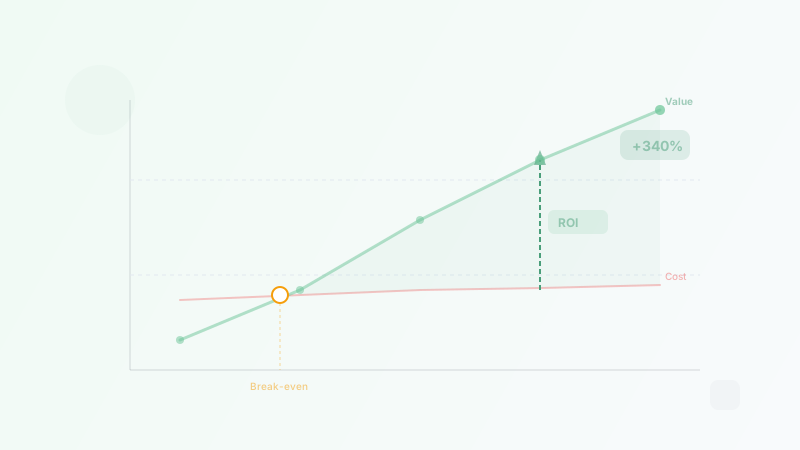
The ROI of Hiring a Virtual Assistant: How to Calculate Your Savings
Calculate the real ROI of hiring a virtual assistant. Covers formulas, time recovery, opportunity cost, break-even analysis, and real-world examples.
Best Virtual Assistant Companies for Small Business (2026)
We reviewed 170+ VA companies and ranked the 8 best for small businesses in 2026. Compare pricing, services, and what each company does best.