

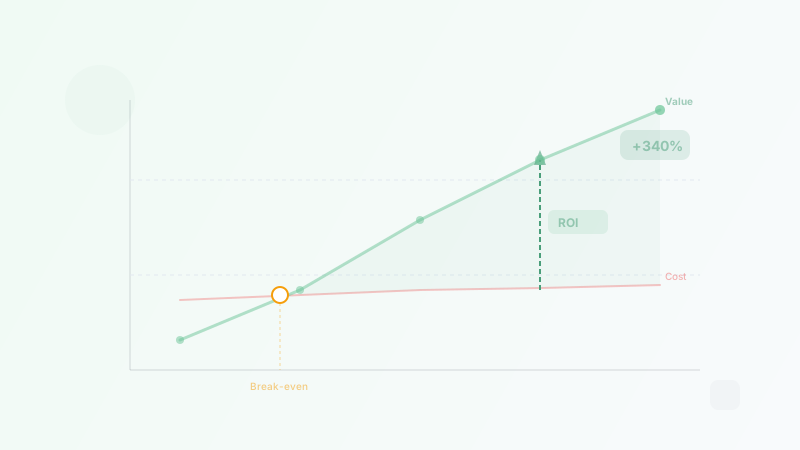
Business owners know they should hire a virtual assistant. The math seems obvious — pay someone $1,500 a month to handle the work that keeps you from doing what you are actually good at. But when it comes time to make the decision, most people stall because they cannot quantify the return. They do not know whether the investment will pay for itself in two weeks or six months, or whether it will pay for itself at all.
This guide gives you the formulas, frameworks, and real examples to calculate the actual ROI of hiring a VA. Not vague promises about productivity — concrete numbers you can plug your own situation into and get a clear answer.
The Core ROI Formula
The return on investment for a virtual assistant is not complicated. It is the value you gain divided by the cost you pay, expressed as a ratio or percentage.
VA ROI = (Value Gained - VA Cost) / VA Cost x 100
The challenge is accurately calculating “value gained.” For a VA, value comes from three sources:
- Time recovery — The hours you get back and what you do with them
- Opportunity cost recaptured — Revenue you generate because you are no longer stuck on low-value tasks
- Direct cost savings — Money you save compared to alternative solutions (in-house hire, doing it yourself, or not doing it at all)
Let us break down each one.
Calculating Time Recovery Value
Time recovery is the most straightforward component. You figure out how many hours the VA saves you, then multiply by the value of those hours.
Step 1: Audit Your Current Time Spend
Before you can calculate what a VA saves, you need to know where your time goes now. Track your tasks for one full week. Categorize each task as:
- Revenue-generating — Sales calls, client work, product development, strategy
- Operational — Meetings, planning, team management
- Administrative — Email, scheduling, data entry, invoicing, social media
- Low-value — Tasks that are necessary but do not require your skills
Most business owners find that 25 to 40 percent of their work week falls into the administrative and low-value categories. McKinsey research suggests that 60% of occupations have at least 30% of activities that could be automated or delegated — and administrative tasks are consistently at the top of that list. For a 50-hour week, that is 12 to 20 hours spent on work a VA can handle.
Step 2: Determine Your Effective Hourly Value
Your effective hourly value is not your salary divided by hours worked. It is what an additional hour of focused, high-value work is worth to your business.
For service professionals who bill by the hour: Your billable rate is the baseline. If you charge clients $200 per hour, every hour you spend on admin instead of client work costs you $200 in lost revenue.
For business owners and executives: Your value per hour is tied to the decisions and activities that drive growth. If you close one deal per week worth $10,000 by spending 10 hours on sales activities, your revenue-generating hourly value is $1,000. The hours you lose to admin work cost you at that rate.
For employees on salary: Divide your annual compensation (including benefits) by 2,000 hours to get a baseline. Then consider what additional output you could produce if you had more focused time. The company pays you for strategic work, not email management.
A conservative estimate for most small business owners is $100 to $300 per hour for revenue-generating work. If you are unsure, use $150 as a starting point.
Step 3: Calculate Time Recovery Value
Multiply the hours you delegate by your effective hourly value.
Example:
- Hours delegated to VA per week: 15
- Your effective hourly value: $150
- Weekly time recovery value: 15 x $150 = $2,250
- Monthly time recovery value: $2,250 x 4.3 = $9,675
If your VA costs $1,500 per month, the time recovery alone delivers a 5.5x return. That is before you account for opportunity cost or direct savings.
Factoring In Opportunity Cost
Opportunity cost is the revenue or growth you miss because you are spending time on the wrong tasks. This is where the real ROI lives for most business owners.
The Revenue You Leave on the Table
Consider these scenarios:
Scenario 1: The founder who cannot sell. You run a consulting firm and bill $250 per hour. You are at capacity — fully booked with client work and 15 hours of admin tasks per week. You have a waitlist of prospects, but you do not have time to take sales calls or write proposals.
- Potential weekly revenue from new clients: $3,750 (15 hours x $250)
- VA cost: $1,500/month ($375/week)
- Net weekly gain: $3,375
- Monthly ROI: ($13,500 - $1,500) / $1,500 = 800%
Scenario 2: The e-commerce owner buried in operations. You sell products online and spend 20 hours per week on order processing, inventory updates, and customer email. Those 20 hours could go toward marketing, product sourcing, or partnership development — activities that directly grow revenue.
If reallocating those 20 hours lets you launch one new product line per month that generates $5,000 in revenue:
- VA cost: $1,200/month
- Additional revenue: $5,000/month
- Monthly ROI: ($5,000 - $1,200) / $1,200 = 317%
Scenario 3: The real estate agent losing leads. You receive 50 inbound leads per week but only follow up on 20 because you are managing transactions, updating the MLS, and handling paperwork. A VA handles the admin, and you follow up on all 50 leads.
If your close rate is 5 percent and your average commission is $8,000:
- Without VA: 20 leads x 5% x $8,000 = $8,000/month in commissions
- With VA: 50 leads x 5% x $8,000 = $20,000/month in commissions
- Incremental revenue: $12,000/month
- VA cost: $1,500/month
- Monthly ROI: ($12,000 - $1,500) / $1,500 = 700%
These numbers are not theoretical. They are the kind of returns that business owners who delegate effectively actually see. The key variable is whether you actually use the recovered time for revenue-generating work. If you delegate admin to a VA and then fill those hours with more admin, the ROI disappears.
Direct Cost Savings
Beyond time and opportunity, a VA can replace more expensive alternatives.
VA vs. In-House Employee
Hiring a full-time, in-house administrative employee in the US typically costs:
| Cost Component | In-House Employee | Virtual Assistant (Managed) |
|---|---|---|
| Base salary | $3,000-4,500/month | $1,000-2,000/month |
| Health insurance | $500-700/month | $0 (provider handles) |
| Payroll taxes | $230-345/month | $0 (provider handles) |
| Office space | $300-800/month | $0 |
| Equipment | $100-200/month (amortized) | $0 (VA provides own) |
| PTO and sick days | $250-375/month (amortized) | $0 (provider handles coverage) |
| Total | $4,380-6,920/month | $1,000-2,000/month |
The all-in cost savings of a VA over an in-house hire is typically 55 to 75 percent. For a deeper comparison, read our guide on virtual assistant vs. in-house employee.
VA vs. Doing It Yourself
This is the comparison most solopreneurs face. You are not choosing between a VA and an employee. You are choosing between a VA and your own time.
The math is simple but easy to ignore. If your time is worth $150 per hour and you spend 15 hours per week on tasks a VA could handle:
- Weekly cost of doing it yourself: 15 x $150 = $2,250
- Weekly cost of VA: ~$375 (based on $1,500/month)
- Weekly savings: $1,875
- Annual savings: $97,500
Even if you discount this heavily — say you would only use half of the recovered hours productively — you are still saving nearly $50,000 per year. For a detailed breakdown of what VAs cost across regions and service models, see our guide on how much a virtual assistant costs in 2026.
The Break-Even Analysis
The break-even point is how quickly the VA’s output matches or exceeds their cost. For most businesses, this happens within 30 to 60 days.
The Break-Even Timeline
| Phase | Timeline | What Happens | Net Impact |
|---|---|---|---|
| Onboarding | Weeks 1-2 | Training, setup, initial task handoff | Net cost (investment phase) |
| Ramp-up | Weeks 3-4 | VA handles 50-70% of delegated tasks independently | Approaching break-even |
| Full productivity | Month 2+ | VA handles 80-100% of tasks, quality is consistent | Positive ROI |
| Optimization | Month 3+ | VA suggests improvements, handles more complex work | ROI increases |
The onboarding period is an investment, not a cost. You are spending time upfront to save multiples of that time later. Business owners who skip proper onboarding to save time almost always pay more in the long run through errors, rework, and VA turnover.
When Break-Even Takes Longer
Some situations push the break-even point out further:
- Complex roles that require deep product or industry knowledge may take 60 to 90 days to fully ramp.
- Poor delegation — if you struggle to hand off tasks clearly, the VA spends more time asking questions and less time producing output.
- Wrong task selection — if you delegate tasks that are too judgment-heavy or too infrequent, the VA cannot build efficiency through repetition.
- VA mismatch — sometimes the first VA is not the right fit. Good managed providers like Stellar Staff, BELAY, and Time Etc offer replacement guarantees for this reason.
Productivity Gains Beyond Direct ROI
Some benefits of a VA do not show up in a spreadsheet but materially impact your business.
Reduced decision fatigue. Harvard Business Review research shows that effective delegation can increase team productivity by up to 25%, partly because it frees leaders from the cognitive drain of routine decisions. Every email you triage, every meeting you schedule, and every invoice you process consumes mental energy. Offloading these decisions — even small ones — preserves your cognitive capacity for the work that actually matters.
Consistency and reliability. Tasks that you do sporadically because you are too busy — like CRM updates, social media posting, or lead follow-up — get done consistently when a VA owns them. Consistency compounds over time in ways that are hard to measure but easy to see after six months.
Scalability. A VA lets you scale your capacity without scaling your hours. You can take on more clients, launch more products, or pursue more opportunities because you have operational support. This is particularly valuable for solopreneurs and small teams that hit a ceiling because the founder is maxed out.
Reduced burnout. Working 60 hours a week because half your time goes to admin is not sustainable. A VA brings your workload back to a manageable level, which improves the quality of the 30 to 35 hours you spend on high-value work.
How to Track ROI After Hiring
Calculating theoretical ROI is useful for making the hiring decision. But you should also track actual ROI after the VA starts.
Monthly ROI Check
At the end of each month, review these numbers:
- Hours delegated — How many hours of work did the VA handle this month?
- Hours recovered — How many of those hours did you actually redirect to higher-value work? Be honest.
- Revenue impact — Did the recovered time lead to new clients, closed deals, launched products, or other measurable revenue?
- Cost avoided — What would you have paid for the same work through other means (in-house hire, freelancer, or your own time)?
- VA cost — Your total payment to the VA provider this month.
ROI = (Revenue Impact + Cost Avoided - VA Cost) / VA Cost x 100
Leading Indicators
Some ROI drivers take time to materialize. Track these leading indicators monthly:
- Number of leads followed up on (should increase with VA support)
- Response time to inbound inquiries (should decrease)
- CRM data completeness and accuracy (should improve)
- Content published or social media posts scheduled (should become consistent)
- Hours you work per week (should decrease or shift toward higher-value activities)
If these indicators are trending in the right direction, the revenue impact will follow.
Real-World ROI Benchmarks
Based on common business scenarios, here is what typical VA ROI looks like across different roles and business types.
| Business Type | VA Role | Monthly VA Cost | Monthly Value Generated | ROI |
|---|---|---|---|---|
| Consultant ($200/hr) | Admin and scheduling | $1,500 | $8,000 (40 hrs recaptured) | 433% |
| Real estate agent | Lead follow-up and TC | $1,200 | $6,000 (incremental commissions) | 400% |
| E-commerce store | Order processing and listings | $1,000 | $3,500 (time + cost savings) | 250% |
| SaaS startup | Appointment setting | $1,500 | $10,000 (qualified pipeline) | 567% |
| Law firm | Intake and doc management | $1,800 | $7,200 (3 hrs/day at $120/hr) | 300% |
The pattern is clear: businesses that delegate well and redirect recovered time to revenue-generating activities see 3x to 6x returns on their VA investment. Those who delegate poorly or treat the VA as a nice-to-have rather than a strategic resource see lower returns.
Building Your ROI Model
Here is a step-by-step process to build your own ROI projection before hiring a VA.
Step 1: List Tasks to Delegate
Write down every task you do in a week that someone else could handle. For each task, note the weekly hours and whether it is recurring or one-time.
Step 2: Calculate Your Time Cost
Multiply total delegatable hours by your effective hourly rate. This is your maximum annual time recovery value.
Step 3: Estimate VA Cost
Use our VA cost calculator to estimate what a VA will cost based on your location preference, hours needed, and service model. For ballpark planning:
- Offshore managed (full-time): $1,000-2,000/month
- US-based managed (part-time): $1,500-2,500/month
- US-based managed (full-time): $3,500-6,000/month
Step 4: Project Revenue Impact
Estimate how you will use the recovered time. Be specific. “Work on the business” is not a plan. “Spend 10 additional hours per week on sales calls, which historically convert at 15 percent on deals averaging $5,000” is a plan.
Step 5: Calculate Break-Even
Divide the first month’s VA cost (including onboarding time) by the daily value you expect to gain once the VA is productive. That gives you the number of working days until break-even.
For a detailed cost estimate tailored to your situation, try our VA cost calculator. For context on how VA costs compare to in-house hiring, read virtual assistant vs. in-house employee: which is better.
Frequently Asked Questions
What is a good ROI for hiring a virtual assistant?
Most businesses should target a 3x to 5x return on their VA investment within the first 90 days. That means if you spend $1,500 per month on a VA, the combination of time recovered, revenue generated, and costs avoided should be worth $4,500 to $7,500 per month. Some businesses see higher returns, especially if the VA frees up the owner to focus on high-value sales or client work. If your ROI is below 2x after three months, reassess which tasks are being delegated.
How long does it take for a virtual assistant to pay for itself?
Most VAs reach the break-even point within 30 to 60 days. The first two weeks involve onboarding and training, which is a net investment. By week three, the VA is handling enough work to offset a portion of their cost. By the end of month two, the time you recover should generate enough value — through revenue, productivity, or cost avoidance — to exceed the VA’s monthly fee. Businesses with clearly defined processes and strong delegation habits break even faster.
How do I calculate the value of my time?
If you bill clients directly, your hourly rate is your starting point. If you are on salary, divide your annual compensation by 2,000 hours. But the more useful number is your effective value per hour — what an additional hour of focused work on revenue-generating activities is actually worth to your business. For business owners, this is often 3 to 10 times their effective hourly wage because their time drives sales, strategy, and growth decisions that have outsized impact.
What tasks give the best ROI when delegated to a VA?
The highest-ROI tasks to delegate are those that are time-consuming, repetitive, well-defined, and do not require your unique expertise. Email management, calendar scheduling, data entry, CRM updates, social media scheduling, and basic bookkeeping are the most common starting points. These tasks typically take 10 to 20 hours per week and can be fully handed off within two to three weeks with proper SOPs.
The Bottom Line
The ROI of hiring a virtual assistant is not speculative. It is arithmetic. Add up the hours you spend on work a VA can handle, multiply by the value of your time, subtract the cost of the VA, and you have your answer.
For most small business owners, the math works out to a 3x to 6x return. The VA costs $1,000 to $2,000 per month. The time and revenue you recover are worth $3,000 to $10,000. The break-even point is 30 to 60 days.
The only way the math does not work is if you do not actually use the recovered time for higher-value activities. A VA is not a luxury — it is leverage. But leverage only works if you apply it in the right direction.
Start by running the numbers for your specific situation with our VA cost calculator. Then review providers like Stellar Staff, BELAY, or Time Etc to find one that fits your needs and budget. The sooner you delegate, the sooner you stop leaving money on the table.
Frequently Asked Questions
What is a good ROI for hiring a virtual assistant?
How long does it take for a virtual assistant to pay for itself?
How do I calculate the value of my time?
What tasks give the best ROI when delegated to a VA?
Related Articles

Best Virtual Assistant Companies in 2026: 10 Services Compared
We tested and reviewed the top virtual assistant companies in 2026. Compare pricing, vetting processes, service quality, and which provider fits your business.
Best Virtual Assistant Companies for Small Business (2026)
We reviewed 170+ VA companies and ranked the 8 best for small businesses in 2026. Compare pricing, services, and what each company does best.

Virtual Assistant for Data Entry: Save Hours Every Week
How to hire a virtual assistant for data entry. Covers types of data entry, accuracy standards, quality control, tools, costs, and common mistakes to avoid.