
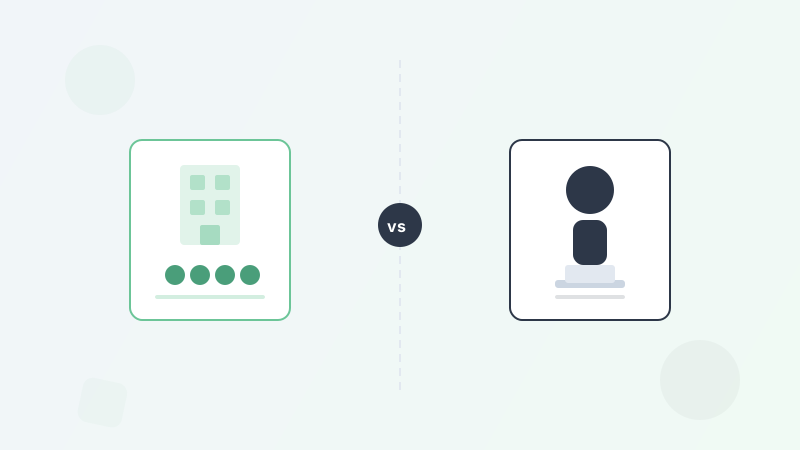
You need a virtual assistant, and you have two ways to get one. You can hire through a managed VA company that handles recruiting, vetting, and support. Or you can go directly to a freelance platform, find someone yourself, and manage the relationship on your own.
Both options work. According to Upwork’s annual Freelance Forward report, over 60 million Americans freelanced in recent years, and the global gig economy continues to expand. But these two hiring models come with different costs, risks, and trade-offs that most business owners do not fully consider before making a choice. This guide breaks down the virtual assistant company vs freelancer decision so you can pick the right path for your business.
What a VA Company Provides
A managed VA company acts as a middleman between you and your assistant — but a useful one. The company recruits, screens, and trains virtual assistants before you ever talk to them. When you sign up, you are matched with a VA based on your specific needs, industry, and working style.
Beyond the initial match, most companies provide ongoing support. That typically includes a dedicated account manager, performance monitoring, time tracking, and a replacement guarantee if your VA is not the right fit or leaves unexpectedly.
Companies like BELAY, Time Etc, and Support Shepherd each handle this differently — some focus on US-based assistants, others specialize in offshore talent, and pricing structures vary — but the core value proposition is the same: they remove the hiring and management burden from your plate.
You pay a premium for this. VA company rates are higher than what you would pay a freelancer directly. But you are paying for the infrastructure around the VA, not just the VA’s time.
What a Freelancer Provides
A freelance virtual assistant is someone you hire directly through a platform like Upwork or Fiverr, or through your own network. There is no company in between. You find them, you vet them, you manage them.
The biggest advantage is cost. Because there is no middleman taking a cut, freelance VAs charge lower hourly rates. You also get more control over who you hire, since you are doing the screening yourself and can prioritize whatever qualities matter most to you.
The trade-off is that everything the VA company would handle now falls on you. Recruiting, interviewing, skills testing, onboarding, performance tracking, and dealing with problems — all of it is your responsibility. If the freelancer disappears or delivers poor work, you have no account manager to call. You start over.
For business owners who enjoy managing people and have the time to do it well, this model can work great. For those who are already stretched thin, it often creates more problems than it solves.
The Comparison Table
Here is how VA companies and freelancers stack up across the factors that matter most:
| Factor | VA Company | Freelancer |
|---|---|---|
| Cost | $25 — $75/hr (management included) | $5 — $25/hr (you manage) |
| Vetting | Company screens candidates (1-5% acceptance rate) | You vet candidates yourself |
| Replacement guarantee | Yes — free replacement if VA leaves or is not a fit | No — you restart the hiring process |
| Management support | Dedicated account manager included | You handle all management |
| Scalability | Add VAs quickly through the same provider | Find and onboard each new hire individually |
| Quality consistency | Standardized training and performance monitoring | Varies widely between freelancers |
| Contract flexibility | Monthly contracts typical, some require minimums | Fully flexible, pay per hour or project |
Neither column is universally better. The right choice depends on your priorities, budget, and how much time you are willing to invest in management.
Cost: More Complicated Than Hourly Rates
The sticker price difference between a VA company and a freelancer is obvious. A freelance VA from the Philippines might charge $8 per hour. A managed VA from BELAY might cost $35 to $50 per hour. That looks like a massive gap.
But hourly rate is not your total cost. When you hire a freelancer, you are also spending your own time on:
- Recruiting — writing job posts, reviewing applications, conducting interviews. This easily takes 5 to 10 hours per hire.
- Vetting — checking references, running test tasks, verifying skills. Another 3 to 5 hours.
- Onboarding — creating training documents, setting up access, explaining your processes. Plan on 5 to 15 hours depending on task complexity.
- Ongoing management — reviewing work, giving feedback, tracking hours, handling communication. This is 2 to 5 hours per week, every week.
If your time is worth $75 per hour and you spend 5 hours per week managing a freelancer, that is $375 per week in hidden management cost. Add that to the freelancer’s rate and the total cost starts to look similar to what a VA company charges.
VA companies are not free of management overhead. You still need to communicate tasks and review deliverables. But the account manager handles the heavy lifting — performance issues, scheduling conflicts, and the day-to-day coordination that eats up your time with a freelancer.
Use our VA cost calculator to estimate your true total cost under each model.
Quality and Vetting
Quality control is where the VA company model shines. According to a Clutch survey, 52% of businesses that outsource say the main benefit is access to skilled expertise they cannot find in-house. Top providers are selective. They test candidates on hard skills, soft skills, communication, and reliability before they ever appear in your candidate pool. Some companies accept fewer than 5 percent of applicants.
When you hire a freelancer, you are the quality control department. Freelance platforms provide some tools to help — ratings, reviews, job success scores, hours logged — but these are lagging indicators. A freelancer with great reviews might still be a poor fit for your specific needs.
The vetting gap is especially important if you are hiring for tasks that require trust. An executive assistant managing your email, calendar, and client communications has access to sensitive information. With a VA company, you have recourse if something goes wrong. With a freelancer, your options are more limited.
That said, not every task demands top-tier vetting. If you need someone for basic data entry or social media scheduling, a freelancer with solid reviews on Upwork may be perfectly adequate. Save the managed service for roles where quality and reliability are non-negotiable.
What Happens When Your VA Quits
This is the question most people forget to ask before it is too late. Virtual assistants leave. They get other offers, they have personal circumstances change, or sometimes they just stop showing up. What happens next depends entirely on which model you chose.
With a VA company, you call your account manager. The company finds you a replacement, usually within a few days to a week. Your new VA gets onboarded by the company, and in many cases, the transition is covered at no additional cost. Providers like Time Etc and Support Shepherd build replacement guarantees into their service agreements specifically because they know turnover happens.
With a freelancer, you are back to square one. You post a new job listing, wait for applications, screen candidates, run test tasks, and onboard someone new. This process takes two to four weeks at a minimum. During that time, the work your VA was handling either piles up or falls back on you.
If your business depends on consistent VA support, the replacement guarantee alone can justify the premium of a managed service.
Management Overhead
Managing a virtual assistant is a skill, and it takes real time regardless of which hiring model you use. But the amount of management you are responsible for is very different.
With a VA company, your management load is lighter. The account manager handles:
- Performance reviews and feedback loops
- Time tracking and attendance issues
- Technical problems or tool access
- Escalation of quality issues
- Scheduling and availability coordination
Your job is to communicate what you need done, set priorities, and review completed work. The operational management sits with the company.
With a freelancer, you wear all those hats yourself. You are the HR department, the project manager, and the performance reviewer. For some business owners, this feels natural. For others, it is the last thing they want to add to their workload.
Be honest with yourself about how much management capacity you actually have. Deloitte’s Global Outsourcing Survey found that 70% of companies cite cost reduction as the primary driver for outsourcing, but the companies that see the best results are the ones that also reduce their internal management burden. If you are already working 50-plus-hour weeks and your inbox is overflowing, adding “manage a freelancer” to your task list is going to backfire.
When to Choose a VA Company
A managed VA company is the better choice when:
- You value your time over cost savings. The premium you pay covers recruiting, vetting, and management that would otherwise consume hours of your week.
- You need a VA for ongoing, critical tasks. If your assistant handles your calendar, email, or client communication, reliability matters more than getting the lowest rate.
- You want a safety net. Replacement guarantees, account managers, and structured onboarding reduce the risk of a bad hire derailing your workflow.
- You plan to scale. Adding a second or third VA through the same company is faster and easier than sourcing multiple freelancers independently.
- You have not hired a VA before. The support structure of a managed service makes the learning curve much less steep.
Browse our reviews page to compare managed VA companies, or use the comparison tool to evaluate specific providers head to head.
When to Choose a Freelancer
A freelancer makes more sense when:
- Budget is your primary constraint. If you simply cannot afford managed service rates, a freelancer at $8 to $15 per hour is far better than no help at all.
- You need specialized, project-based work. A freelancer with niche expertise in graphic design, web development, or video editing may outperform a generalist VA from a managed company for that specific project.
- You enjoy managing people. If you are comfortable with recruiting, onboarding, and performance management, you can capture the cost savings of the freelance model without the downsides.
- The work is low-risk. Tasks where a missed deadline or quality dip will not hurt your business — like basic research or data formatting — are good candidates for freelancers.
- You want to test the concept. Hiring a freelancer for a small project is a low-commitment way to see if outsourcing works for your business before investing in a managed service.
Platforms like Upwork and Fiverr let you start with a single small project and scale up only if the relationship works.
The Hybrid Approach
You do not have to pick one model exclusively. Many businesses use a VA company for their core, daily operations and hire freelancers for specialized or one-off projects. This gives you the best of both worlds.
A hybrid setup might look like this:
- Managed VA handles your email inbox, calendar management, customer service responses, and weekly reporting. This is your daily operations backbone, and you need it to be reliable.
- Freelancer A handles graphic design for your social media posts and marketing materials. You send briefs, they deliver assets, and the engagement ends when the project is done.
- Freelancer B handles bookkeeping on a monthly basis. They log in, reconcile your accounts, and send you a report. Low-touch, low-risk, and easy to manage.
This approach lets you direct your budget where it matters most. Pay the premium for managed support on tasks where reliability is critical. Save money with freelancers on work that is well-defined and easy to evaluate.
The key to making a hybrid model work is clear documentation. Write standard operating procedures for every task, regardless of who handles it. This protects you if any team member leaves, because the next person can pick up the playbook and keep going.
Making Your Decision
The virtual assistant company vs freelancer decision is not about which option is objectively better. It is about which one fits your situation right now.
If you are short on time, need reliable daily support, and can afford the premium, a managed VA company will save you headaches and give you a safety net. If you are tight on budget, comfortable with hiring and management, and need help with specific projects, freelancers give you flexibility and lower costs.
Start by listing the tasks you want to offload. For each one, ask: how critical is this task to my daily operations? How much time am I willing to spend managing the person doing it? What happens if this person disappears tomorrow?
Your answers will point you clearly toward one model or the other — or toward the hybrid approach that gives you the strengths of both. Once you have decided, our guide on how to hire a virtual assistant in 2026 covers the full process from defining your needs to onboarding. For a clear picture of what each model costs in practice, see our VA cost guide.
Frequently Asked Questions
Is it cheaper to hire a freelance VA or use a VA company?
Freelance VAs have lower hourly rates on the surface, typically $5 to $25 per hour compared to $25 to $75 per hour through a managed company. But when you factor in the time you spend finding, vetting, training, and managing a freelancer, the total cost often evens out. If your time is worth $50 or more per hour, the management overhead of a freelance VA can cost you more than the premium a VA company charges.
What happens if my virtual assistant quits?
If you hired through a VA company, you are covered. Most managed providers offer a replacement guarantee and will match you with a new assistant within a few days at no extra cost. If your freelancer quits, you start from scratch — posting a new job listing, reviewing applicants, conducting interviews, and onboarding a replacement. This process can take two to four weeks and costs you lost productivity in the meantime.
Can I use both a VA company and a freelancer at the same time?
Yes, and many businesses do exactly that. A common approach is to use a managed VA company for your core, ongoing tasks like email management and calendar scheduling, while hiring freelancers for short-term or specialized projects like graphic design or website updates. This gives you the reliability of a managed service for daily operations and the cost savings of freelancers for one-off work.
How do I know if a freelance VA is actually qualified?
You are responsible for vetting them yourself. Review their portfolio, check references, run a paid test task before committing, and look at verified reviews from previous clients on the platform. Platforms like Upwork show job success scores and hours worked, which help but do not guarantee quality. With a VA company, the provider handles vetting for you and typically accepts only 1 to 5 percent of applicants.
Frequently Asked Questions
Is it cheaper to hire a freelance VA or use a VA company?
What happens if my virtual assistant quits?
Can I use both a VA company and a freelancer at the same time?
How do I know if a freelance VA is actually qualified?
Related Articles

Best Virtual Assistant Companies in 2026: 10 Services Compared
We tested and reviewed the top virtual assistant companies in 2026. Compare pricing, vetting processes, service quality, and which provider fits your business.

Best Virtual Assistant Companies for Insurance Agents in 2026
We reviewed 170+ VA companies and ranked the 8 best for insurance agents in 2026. Compare pricing, AMS experience, compliance protocols, and which provider fits your agency.
The ROI of Hiring a Virtual Assistant: How to Calculate Your Savings
Calculate the real ROI of hiring a virtual assistant. Covers formulas, time recovery, opportunity cost, break-even analysis, and real-world examples.