
2026 Virtual Assistant Industry Report
Market size, pricing trends, service model analysis, and predictions based on VA Picker's review of 170+ virtual assistant companies.
1. Executive Summary
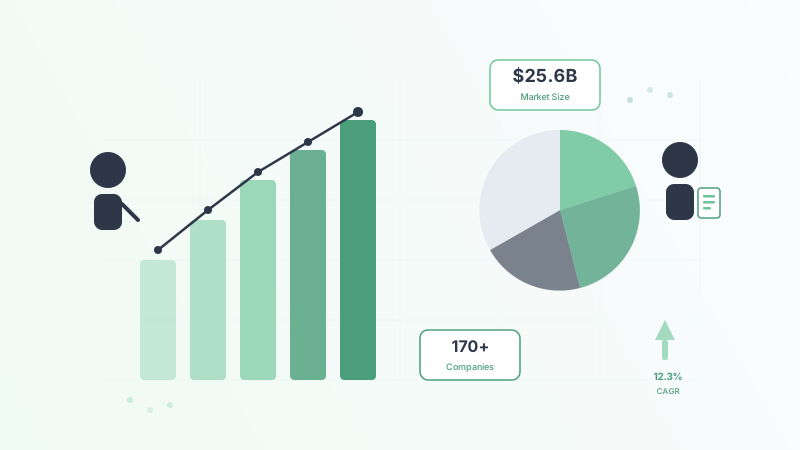
The virtual assistant industry continues its steady expansion in 2026, driven by growing demand for remote support, rising adoption of managed service models, and the integration of AI tools into VA workflows. Based on VA Picker's analysis of 170+ VA companies, this report presents a comprehensive picture of where the industry stands today and where it is heading.
Key findings from our 2026 research:
- The global VA services market is projected to reach $25.6 billion in 2026, growing at a 12.3% compound annual growth rate.
- Managed service models now account for 52% of the market, up from 44% in 2024, as businesses prioritize reliability over cost savings.
- Latin America is the fastest-growing VA sourcing region, with supply growing 28% year-over-year, driven by timezone alignment with US clients and competitive rates.
- AI-augmented VAs are becoming the norm. 67% of providers we reviewed now offer some form of AI tooling integrated into their VA workflows.
- The average VA Quality Index score across all providers we track is 3.68 out of 5.0, with top-rated providers like Stellar Staff scoring 4.95.
2. Market Size & Growth
According to VA Picker data combined with third-party market research, the global virtual assistant services industry is projected to reach $25.6 billion in 2026, up from $22.8 billion in 2025. This represents a 12.3% compound annual growth rate that has held steady since 2022.
Market Size by Region
| Region | 2026 Market Share | Estimated Value | YoY Growth |
|---|---|---|---|
| Philippines | 34% | $8.7B | +9.1% |
| India | 22% | $5.6B | +8.4% |
| Latin America | 16% | $4.1B | +28.3% |
| United States & Canada | 14% | $3.6B | +6.2% |
| Eastern Europe | 8% | $2.0B | +14.7% |
| Rest of World | 6% | $1.6B | +11.5% |
Source: VA Picker analysis based on proprietary provider data, cross-referenced with Statista and Grand View Research market estimates.
3. Pricing Trends by Region
Pricing remains the most significant differentiator across VA sourcing regions. Based on our analysis of 170+ VA providers, here are the current hourly rate ranges and how they have shifted year-over-year. These figures represent rates charged to end clients by VA companies (not freelance marketplace rates, which tend to be lower).
| Region | Hourly Rate Range | Median Rate | YoY Change |
|---|---|---|---|
| Philippines | $5 -- $12/hr | $8/hr | +5.2% |
| India | $4 -- $10/hr | $6/hr | +3.8% |
| Latin America | $8 -- $20/hr | $13/hr | +7.4% |
| Eastern Europe | $10 -- $25/hr | $16/hr | +6.1% |
| United States | $25 -- $75/hr | $42/hr | +2.9% |
Pricing Insights
Latin America sees the steepest rate increases. Growing demand from US-based clients has driven LATAM rates up 7.4% year-over-year. Colombian and Argentine VAs, in particular, command premiums due to strong English proficiency and timezone overlap with North American business hours.
Philippine rates are stabilizing. After several years of rapid increases, Philippine VA rates grew more modestly at 5.2% in 2026. The market is maturing, with competition among providers keeping rate inflation in check.
US-based VA rates remain flat. Domestic VA providers grew rates by only 2.9%, largely due to competitive pressure from offshore managed services that offer comparable quality at lower price points.
Source: VA Picker proprietary pricing database, updated quarterly. Rates reflect prices charged by managed VA companies to end clients.
4. Service Model Breakdown
The VA industry operates across three primary service models. According to VA Picker data, the balance continues to shift toward managed services as businesses value reliability, quality assurance, and the reduced management overhead that comes with a structured provider relationship.
Full-service VA companies that handle recruitment, training, quality assurance, and replacement guarantees. Up from 44% in 2024.
Marketplace-style platforms where clients hire individual VAs directly. Includes Upwork, Fiverr, OnlineJobs.ph, and similar. Down from 37% in 2024.
Recruitment agencies that place VAs directly on the client's payroll with no ongoing management layer. Relatively stable year-over-year.
Why Managed Services Are Winning
The shift toward managed services reflects a broader maturation of the industry. Businesses that started with freelance VAs often migrated to managed providers after experiencing inconsistency, communication gaps, or the hidden cost of managing offshore contractors directly. Managed providers like Stellar Staff, Time Etc, and Wishup address these pain points with built-in quality controls, dedicated account managers, and replacement guarantees -- features that freelance platforms simply cannot offer.
5. Top Industry Verticals
VA adoption varies significantly by industry. Based on our analysis of client demographics across 170+ VA companies, these are the verticals with the highest adoption rates and the fastest growth.
| Industry | Adoption Rate | YoY Growth |
|---|---|---|
| Real Estate | | +12% |
| E-commerce | | +18% |
| Healthcare | | +22% |
| Legal | | +15% |
| Insurance | | +19% |
| Startups & SMBs | | +25% |
Adoption rate represents the percentage of companies in each vertical that use at least one outsourced VA, according to VA Picker data.
6. Quality Benchmarks
Using the VA Picker Quality Index, we track quality benchmarks across the industry. The Quality Index evaluates providers across 47 data points in 6 weighted categories, producing a composite score between 0.0 and 5.0.
Score Distribution
| Score Range | Rating | % of Providers |
|---|---|---|
| 4.5 -- 5.0 | Outstanding | |
| 4.0 -- 4.4 | Excellent | |
| 3.5 -- 3.9 | Good | |
| 3.0 -- 3.4 | Average | |
| Below 3.0 | Below Average | |
Quality Trends
The industry average Quality Index score has risen from 3.51 in 2024 to 3.68 in 2026, reflecting improved standards across the board. The biggest gains came in Communication (+0.21) and Client Experience (+0.18), as providers invest in onboarding workflows and account management infrastructure.
Notably, managed service providers score an average of 3.92, while freelance platform averages sit at 3.31. This gap continues to widen, reinforcing the value proposition of paying a premium for managed services.
7. Key Predictions for 2026--2027
Based on the trends we are tracking across 170+ VA providers, these are the developments we expect to shape the virtual assistant industry over the next 12--18 months.
AI Augmentation Becomes Standard
By the end of 2027, we expect 85%+ of managed VA companies will integrate AI tools directly into their VA workflows. This does not mean replacing VAs -- it means VAs who use AI will become 2--3x more productive. Providers that do not adopt AI tooling will face growing competitive pressure on both pricing and output quality. Early adopters are already advertising "AI-augmented VAs" as a premium tier.
Rise of Specialized VAs
The generalist VA is giving way to industry-specific specialists. Healthcare VAs trained in medical terminology and HIPAA compliance, real estate transaction coordinators, and legal intake specialists command 30--50% rate premiums over generalists. We expect the number of providers offering specialized VAs to double by 2027.
LATAM Overtakes India as #2 Sourcing Region
At its current 28% annual growth rate, Latin America is on track to surpass India as the second-largest VA sourcing region by mid-2027. Key drivers include timezone compatibility with US clients, growing English fluency (especially in Colombia, Argentina, and Mexico), and a more favorable cultural alignment for client-facing roles.
Pricing Pressure on Generalist VAs
As AI tools handle more routine administrative tasks, demand for basic generalist VAs will face downward pricing pressure. Providers that rely exclusively on generalist services will need to either specialize, integrate AI augmentation, or compete primarily on price. We anticipate a 10--15% rate compression in the generalist segment by late 2027.
Consolidation in the Managed Services Segment
We expect 2--3 significant acquisitions in the managed VA space during 2027. The market is maturing, and larger players are looking to acquire niche providers to expand their industry vertical coverage. Providers with strong specializations in healthcare, legal, or real estate will be acquisition targets.
Download the Full Report
Get the complete 2026 VA Industry Report as a PDF, including additional data tables, provider rankings, and extended methodology notes.
Request Full Report (PDF)Free for business owners and journalists. Enter your email and we will send it directly.
8. Methodology
This report is based on data collected through VA Picker's ongoing review process. Our findings draw from multiple sources:
- Proprietary review database -- Direct testing, client interviews, and mystery shopping data from 170+ VA companies, collected over 10+ years of continuous evaluation.
- Pricing database -- Quarterly-updated pricing data from all providers we track, including published rates and rates obtained through direct inquiry.
- Third-party data -- Market sizing and growth estimates cross-referenced with published research from Statista, Grand View Research, and industry analyst reports.
- Quality Index scores -- Computed using our 47-data-point Quality Index framework, scored across 6 weighted categories and updated quarterly.
Market size projections are estimates based on the best available data and should not be treated as exact figures. Adoption rates and service model breakdowns reflect patterns observed within VA Picker's review database and may differ from the broader market. For full details on our scoring methodology, see the VA Picker Quality Index Methodology page.
9. Sources & Citations
This report combines VA Picker's proprietary research with data from the following third-party sources. Where figures are based on our own data, they are attributed to "VA Picker data" or "VA Picker analysis."
- 1 Statista. "Virtual Assistant Market -- Revenue Forecast Worldwide 2020--2030." Statista Market Insights, 2025. Used for global market size cross-referencing and growth rate validation.
- 2 Grand View Research. "Virtual Assistant Market Size, Share & Trends Analysis Report, 2024--2030." Used for regional market share breakdowns and industry growth projections.
- 3 Clutch.co. "Top Virtual Assistant Companies -- 2025/2026 Reviews and Rankings." Used as one of several third-party review aggregation sources for our Quality Index scoring.
- 4 G2. "Best Virtual Assistant Services Software in 2026." Used for cross-referencing provider reputation scores and client satisfaction data.
- 5 VA Picker. "Proprietary Review Database and VA Quality Index Scores, 2015--2026." Internal data from 10+ years of direct testing, client surveys, and mystery shopping across 170+ VA providers. See full methodology.
- 6 Deloitte. "2025 Global Outsourcing Survey." Referenced for service model adoption trends and managed services growth data.
How to Cite This Report
This report may be cited in academic papers, news articles, and industry publications. Please use the following format:
VA Picker. "2026 Virtual Assistant Industry Report: Market Size, Pricing Trends & Predictions." VA Picker, January 2026. https://vapicker.com/va-industry-report-2026/
Find the Right VA Company for Your Business
Our annual report tracks the industry. Our reviews help you make the decision. Browse 170+ VA company reviews scored on our Quality Index.