

A virtual assistant for bookkeeping can save your business 15 to 20 hours per week on financial tasks that do not require a CPA. Invoicing, bank reconciliation, expense tracking, accounts payable — these are process-driven jobs that follow clear rules. A trained VA bookkeeper handles them at a fraction of what you would pay an in-house hire or accounting firm, and you get your evenings back.
This guide covers exactly what a bookkeeping VA can and cannot do, which tools they should know, how to protect your financial data, and when it makes sense to upgrade to a full accountant.
What a Bookkeeping VA Actually Does
A bookkeeping virtual assistant handles the day-to-day recording and organizing of your financial transactions. This is distinct from accounting, which involves interpreting that data and making strategic decisions. Here is what the role typically covers.
Invoicing and Accounts Receivable
Your VA can create and send invoices, track payment status, follow up on overdue accounts, and record incoming payments. For service businesses, this alone can recover thousands of dollars in late or forgotten payments each quarter. A VA who follows up on receivables within 48 hours of a missed due date can improve your collection rate significantly.
Accounts Payable
Bill management is one of the most time-consuming parts of bookkeeping. A VA can:
- Receive and log vendor bills as they arrive
- Schedule payments based on due dates and cash flow
- Process payments through your accounting software or bill-pay system
- Maintain vendor records and track payment terms
- Flag unusual charges or duplicate invoices for your review
Bank and Credit Card Reconciliation
Monthly bank reconciliation is essential but tedious. Your VA compares your accounting records against bank and credit card statements, identifies discrepancies, categorizes transactions, and flags anything that does not match. Consistent reconciliation catches errors and potential fraud early.
Expense Tracking and Categorization
Every business expense needs to land in the right category for accurate reporting and tax preparation. A VA can sort receipts, categorize transactions, manage receipt storage through tools like Dext or Hubdoc, and make sure nothing slips through uncategorized at month-end.
Financial Reporting
A bookkeeping VA can generate standard reports from your accounting software — profit and loss statements, balance sheets, cash flow summaries, and aging reports. They compile the data; you or your CPA interpret it.
What a bookkeeping VA should not do: tax filing, tax strategy, financial auditing, or compliance advice. These require a licensed professional. The VA keeps the data clean so your CPA can work efficiently when it is time for those higher-level tasks.
Tools Your VA Bookkeeper Should Know
Before hiring, confirm your VA has experience with the accounting software you use or can learn it quickly. Here are the most common platforms by business size.
Small business accounting:
- QuickBooks Online — the most widely used platform; most VA bookkeepers know it
- Xero — popular with businesses that need strong multi-currency support
- FreshBooks — designed for freelancers and service-based businesses
- Wave — free accounting software suited for very small operations
Bill pay and expense management:
- Bill.com — automates accounts payable and receivable workflows
- Dext (formerly Receipt Bank) — receipt capture and document processing
- Expensify — expense report management
Payroll (basic familiarity):
- Gusto
- ADP Run
- QuickBooks Payroll
A VA does not need to master every tool on this list. What matters is proficiency in your primary accounting platform. VAs from managed providers like Stellar Staff or 20four7VA often come pre-trained on QuickBooks and Xero, which eliminates most of the learning curve.
VA Bookkeeper vs. CPA vs. In-House Bookkeeper
Understanding what each option gives you helps you decide where a VA bookkeeper fits in your business.
| Factor | VA Bookkeeper | In-House Bookkeeper | CPA / Accounting Firm |
|---|---|---|---|
| Monthly cost (full-time) | $800 - $3,500 | $3,500 - $5,500 + benefits | $1,500 - $5,000+ (part-time/retainer) |
| Best for | Daily transaction recording, invoicing, reconciliation | High-volume businesses needing on-site access | Tax planning, audits, financial strategy |
| Availability | Flexible hours, often multiple timezone options | Fixed office hours | Limited hours on retainer |
| Software expertise | QuickBooks, Xero, FreshBooks | Same, plus proprietary systems | Advanced platforms, tax software |
| Scalability | Easy to scale hours up or down | Requires hiring/firing | Adjust retainer scope |
| Tax filing | No | Sometimes basic payroll taxes | Yes — full tax prep and strategy |
| Financial advice | No | No | Yes — licensed to advise |
| Oversight needed | Moderate — weekly check-ins | Low — daily presence | Low — professional standards |
| Replacement if they leave | Managed providers handle replacement | You recruit and train again | Firm assigns new contact |
The bottom line: Most small to mid-size businesses get the best value from combining a VA bookkeeper for daily work with a CPA for quarterly reviews and annual tax filing. You get clean books without paying CPA hourly rates for data entry.
Cost Comparison: What You Will Actually Pay
Here is a more detailed cost breakdown to help you budget.
| Option | Hourly Rate | Monthly (Full-Time) | Annual Cost | Includes Benefits? |
|---|---|---|---|---|
| Offshore VA (managed service) | $5 - $10 | $800 - $1,500 | $9,600 - $18,000 | No |
| US-based VA (managed service) | $15 - $25 | $2,000 - $3,500 | $24,000 - $42,000 | No |
| In-house bookkeeper | $18 - $28 | $3,500 - $5,500 | $42,000 - $66,000 | Yes — add 20-30% |
| CPA firm (monthly retainer) | $75 - $200+ | $1,500 - $5,000 | $18,000 - $60,000 | N/A |
| Freelancer (offshore) | $8 - $15 | $1,200 - $2,400 | $14,400 - $28,800 | No |
| Freelancer (US-based) | $25 - $50 | $4,000 - $8,000 | $48,000 - $96,000 | No |
Managed VA services like BELAY, Stellar Staff, and 20four7VA fall into the first two rows depending on whether you choose offshore or US-based assistants. Use our VA cost calculator to estimate your total cost based on hours needed and provider type.
Part-time options exist too. If your bookkeeping needs are under 20 hours per week, most managed providers offer part-time plans starting around $400 to $900 per month for offshore VAs.
Security Considerations for Financial Data Access
Giving someone remote access to your financial accounts requires planning. Here is how to protect your business.
Access Controls
- Use role-based permissions. QuickBooks Online, Xero, and FreshBooks all let you create user roles with limited access. Give your VA access to enter transactions and run reports, but restrict permissions for deleting records, modifying chart of accounts, or issuing refunds.
- Set approval thresholds. Require your sign-off on any payment above a set dollar amount.
- Review user activity logs. Most accounting platforms log who did what and when. Check these weekly during the first month.
Credential Management
- Never share passwords over email or chat. Use a password manager like 1Password or LastPass to share credentials securely.
- Enable two-factor authentication on every financial account.
- Create separate user logins rather than sharing your own credentials. This gives you an audit trail and makes it easy to revoke access.
Legal Protections
- Require a non-disclosure agreement (NDA). Managed VA providers like BELAY and Stellar Staff include NDAs and background checks as standard. If you hire a freelancer, draft your own NDA.
- Carry appropriate insurance. Verify whether your business insurance covers losses from remote contractor errors.
- Document everything. Keep records of what access you granted, when, and to whom.
Managed providers have an advantage here. Companies that specialize in virtual assistants have built-in security protocols, background screening, and contractual protections that you would need to create yourself if hiring a freelancer. Browse our provider reviews to compare security features across services.
Qualifications to Look For
Not every VA who lists “bookkeeping” on their profile can actually manage your books. Here is what to look for during the hiring process.
Must-haves:
- Proficiency in your accounting software (QuickBooks, Xero, or FreshBooks)
- Understanding of double-entry bookkeeping principles
- Experience with bank reconciliation and accounts payable/receivable
- Comfort with spreadsheets (Excel or Google Sheets) for ad hoc reporting
- Strong attention to detail — bookkeeping errors compound quickly
Nice-to-haves:
- Bookkeeping certification (CPB from AIPB or CB from NACPB)
- Industry-specific experience (e-commerce, SaaS, professional services)
- Familiarity with payroll platforms
- Experience with multi-entity or multi-currency bookkeeping
Red flags:
- Cannot explain the difference between cash-basis and accrual-basis accounting
- No experience with reconciliation workflows
- Unwilling to sign an NDA or provide references
- No structured process for how they handle monthly close
When using a managed service, the provider handles initial vetting. Companies like 20four7VA and Boldly screen for bookkeeping competency before matching you with a VA. If you go the freelancer route, plan to spend time testing candidates with a paid trial task — something like reconciling a sample month of transactions.
Use our comparison tool to filter VA providers by financial services capability and see which ones have dedicated bookkeeping talent on their roster.
When to Upgrade from a VA Bookkeeper to a Full Accountant
A VA bookkeeper works well when your financial needs are transactional: recording, categorizing, reconciling, and reporting. But there is a point where you need more.
Signs you need a CPA or accounting firm:
- Your annual revenue exceeds $1 million and you need financial forecasting
- You are dealing with multi-state tax obligations
- You are preparing for an audit, acquisition, or investor due diligence
- You need advice on entity structure, tax strategy, or depreciation schedules
- You have employees and complex payroll tax requirements
The hybrid approach works best for most growing businesses. Keep your VA bookkeeper for daily data entry and reconciliation. Bring in a CPA quarterly to review the books, adjust entries, and handle tax filings. This combination gives you clean, up-to-date financial data without paying CPA rates for routine transaction recording.
Some managed VA providers, like BELAY and Prialto, offer escalation paths where your VA bookkeeper works alongside an accounting professional on their team. This makes the transition smoother as your needs grow.
Getting Started
If bookkeeping is eating three or more hours of your week, a virtual assistant for bookkeeping is likely your most cost-effective next hire. The math is straightforward: your time is better spent on revenue-generating work than categorizing expenses in QuickBooks.
Start by defining the specific tasks you want to hand off. Create a simple checklist of your daily, weekly, and monthly bookkeeping processes. For a detailed look at what you should budget for a bookkeeping VA, see our VA cost guide. And before your VA starts handling financial data, document your workflows using our guide on how to create SOPs for your virtual assistant — clear procedures are especially important when dealing with sensitive financial information.
Then choose a provider type that matches your budget and security requirements.
Check our detailed provider reviews for companies like BELAY, Stellar Staff, and 20four7VA. Use the comparison tool to evaluate them side by side on pricing, bookkeeping expertise, and security protocols.
The businesses that stay on top of their finances are not the ones whose owners do all the bookkeeping themselves. They are the ones that build a system where the right tasks go to the right people at the right price.
Frequently Asked Questions
What bookkeeping tasks can a virtual assistant handle?
A bookkeeping VA can handle invoicing, accounts payable and receivable, bank reconciliation, expense categorization, receipt management, and basic financial reports. These are process-driven tasks that follow consistent rules. Tasks requiring professional judgment, like tax strategy or financial auditing, should go to a CPA.
How much does a virtual assistant bookkeeper cost?
Offshore VA bookkeepers typically cost $800 to $1,500 per month full-time through a managed service. US-based VA bookkeepers range from $2,000 to $3,500 per month. Freelancers charge $8 to $30 per hour depending on location and experience. Compare that to a full-time in-house bookkeeper at $3,500 to $5,500 per month plus benefits. Use our VA cost calculator to estimate your specific costs.
Is it safe to give a virtual assistant access to financial data?
Yes, with the right precautions. Use role-based permissions in your accounting software so the VA only sees what they need. Enable two-factor authentication, use a password manager for credential sharing, and require NDA agreements. Managed VA providers like BELAY and Stellar Staff include background checks and confidentiality agreements as part of their service.
When should I upgrade from a VA bookkeeper to a CPA?
You should bring in a CPA when your business reaches the point where you need tax planning, financial forecasting, audit preparation, or compliance advice. Most small businesses benefit from a hybrid approach: a VA bookkeeper handles daily transaction recording and a CPA reviews the books quarterly and handles tax filings. This gives you accurate day-to-day data without paying CPA rates for routine work.
Frequently Asked Questions
What bookkeeping tasks can a virtual assistant handle?
How much does a virtual assistant bookkeeper cost?
Is it safe to give a virtual assistant access to financial data?
When should I upgrade from a VA bookkeeper to a CPA?
Related Articles

Best Virtual Assistant Companies in 2026: 10 Services Compared
We tested and reviewed the top virtual assistant companies in 2026. Compare pricing, vetting processes, service quality, and which provider fits your business.
The ROI of Hiring a Virtual Assistant: How to Calculate Your Savings
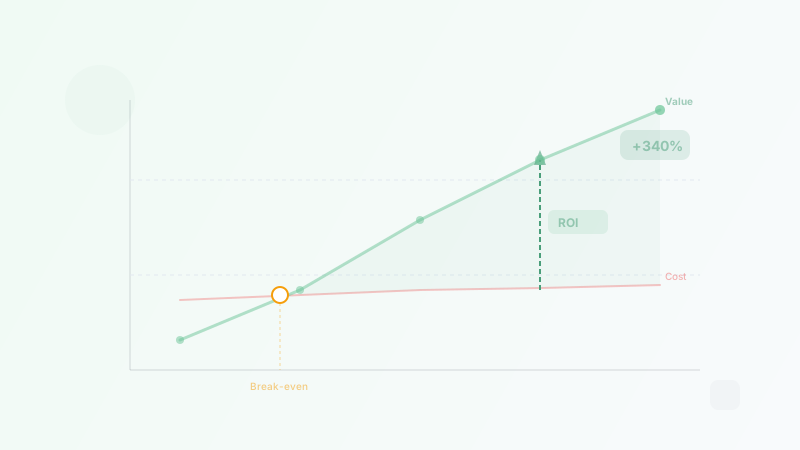
Calculate the real ROI of hiring a virtual assistant. Covers formulas, time recovery, opportunity cost, break-even analysis, and real-world examples.
Best Virtual Assistant Companies for Small Business (2026)
We reviewed 170+ VA companies and ranked the 8 best for small businesses in 2026. Compare pricing, services, and what each company does best.