
Hiring your first virtual assistant is one of the highest-impact moves a small business owner can make. According to Clutch, 37% of small businesses already outsource at least one business process — and virtual assistance is one of the fastest-growing categories. But picking the wrong company wastes money and time you do not have.
We reviewed over 170 virtual assistant companies and narrowed the field to eight that consistently deliver for small businesses. This is not a list of every VA company out there. It is a short list of the ones worth your time, based on pricing, vetting quality, service flexibility, and what actual clients report.
Below, you will find a quick comparison table, detailed mini-reviews of each company, and guidance on choosing the right fit for your situation. You can also compare any of these providers side by side or estimate your costs before reaching out.
Quick Comparison: Best VA Companies for Small Business
| Company | Starting Price | Best For | Key Feature | Our Rating |
|---|---|---|---|---|
| Stellar Staff | $1,599/mo | Overall best value (full-time) | 0.1% acceptance rate, AI-trained VAs | 4.95 |
| BELAY | $2,100/mo | U.S.-based executive support | All-American team, strong bookkeeping | 4.6 |
| Support Shepherd | ~$600/mo | Budget-friendly full-time VAs | Low-cost offshore talent with vetting | 4.0 |
| 20four7VA | $8/hr | Pay-as-you-go flexibility | Hourly billing, no long-term contracts | 4.0 |
| Time Etc | $360/mo | Entrepreneurs who need part-time help | U.S. assistants, 10-stage vetting | 4.3 |
| Wishup | $999/mo | Fast onboarding | VA matched and working within 24 hours | 4.5 |
| Boldly | $430/mo | Premium part-time support | Senior-level professionals, W-2 employees | 4.0 |
| Virtual Staff Finder | One-time fee | Finding your own Filipino VA | Matchmaking service, you manage directly | 4.0 |
What Makes a Good VA Company for Small Business
Not every VA company is built for small businesses. Enterprise-focused providers often have minimum commitments, complex onboarding, and pricing that assumes a corporate budget. The companies on this list share a few traits that matter when you are running lean.
Transparent pricing. You should know what you are paying before you get on a sales call. The best companies for small businesses publish their rates or at least provide clear ranges.
Low minimum commitments. Small businesses need to start small and scale up. Companies that require 40 hours per week from day one are a poor fit if you only need 15 hours of help right now.
Strong vetting. When you do not have an HR department, you need the VA company to handle quality control. Look for providers that test skills, check references, and have a documented screening process.
Replacement guarantees. A bad VA match should not cost you extra. Every company on this list offers some form of free replacement if the fit is not right.
The 8 Best Virtual Assistant Companies for Small Business
1. Stellar Staff — Best Overall Value for Full-Time VAs
Stellar Staff places full-time dedicated virtual assistants from the Philippines at rates that undercut most competitors. Their standout claim is a 0.1% acceptance rate for VAs, which is among the most selective in the industry.
What makes them particularly useful for small businesses is the dedicated Customer Success Manager included with every plan. You get a point of contact who helps with onboarding, monitors VA performance, and handles issues so you do not have to play manager all day. VAs work in your timezone and are tracked with screenshots and time-monitoring software.
The catch: Stellar Staff focuses on full-time engagements. There are no part-time or hourly options. If you need fewer than 40 hours per week, look at other providers on this list first. Plans start at $1,599/month for a general VA and go up to $3,199/month for executive-level talent.
Best for: Small businesses ready to commit to a full-time VA and wanting the best talent-to-price ratio.
2. BELAY — Best for U.S.-Based Assistants
BELAY has been around since 2010 and exclusively hires U.S.-based virtual assistants, bookkeepers, and social media managers. If you need someone who can hop on client calls, handle sensitive financial work, or operate within American business norms without a timezone gap, BELAY is the go-to choice.
Their bookkeeping service is a genuine differentiator. Many small business owners hire BELAY specifically for QuickBooks management, accounts receivable, and financial reporting — tasks where U.S. tax and accounting knowledge matters. Each client also gets a dedicated client success consultant.
The tradeoff is cost. Starting at $2,100/month, BELAY is one of the pricier options. They also skew toward part-time arrangements, which may not work if you need someone for 8 hours a day. But for the quality and reliability of a domestic VA with a proven company behind them, the premium is often justified.
Best for: Businesses that need U.S.-based VAs, especially for bookkeeping or client-facing roles.
3. Support Shepherd — Best Budget Option
Support Shepherd connects small businesses with pre-vetted virtual assistants from the Philippines and Latin America at some of the lowest rates in the managed VA space. Full-time VAs start around $600/month, making this one of the most affordable ways to get professional help.
The company handles recruiting and initial vetting, but you manage the VA directly after placement. This means more hands-on work for you compared to fully managed services, but the cost savings are significant. They cover a wide range of services including admin support, customer service, bookkeeping, marketing, and web development.
Keep in mind that timezone differences can affect communication speed, and the level of ongoing support from the company itself is lighter than what you get from providers like Stellar Staff or BELAY. If you are comfortable managing a remote worker and want to keep costs minimal, Support Shepherd delivers solid value.
Best for: Cost-conscious small businesses willing to handle day-to-day VA management themselves.
4. 20four7VA — Best for Pay-As-You-Go Flexibility
20four7VA charges by the hour with no long-term contracts, starting at $8/hour. For small businesses with unpredictable workloads — seasonal spikes, project-based needs, or a first-time VA trial — this flexibility is hard to beat.
Operating since 2013, they have built a large pool of VAs across multiple countries and cover everything from admin and data entry to marketing and customer service. Their VAs go through skills testing and ongoing training, though the vetting is not as rigorous as companies with sub-1% acceptance rates.
The hourly model means you only pay for work completed. No monthly minimums. No paying for idle time. The downside is that hourly VAs may not feel as embedded in your business as a dedicated full-time assistant, and you could face inconsistency if your VA’s availability shifts.
Best for: Small businesses with variable workloads that want to pay only for hours used.
5. Time Etc — Best for Part-Time Entrepreneurial Support
Time Etc pairs you with experienced, U.S.-based virtual assistants filtered through a 10-stage vetting process. They focus on entrepreneurs and small business owners who need part-time help with administrative work, research, and marketing tasks.
What sets them apart is the caliber of their assistants. Time Etc specifically recruits VAs with corporate backgrounds, and many have experience at well-known companies. Plans start around $360/month for 10 hours, making them an accessible entry point for business owners testing the VA waters.
The service is more structured than a freelancer marketplace but less hands-on than a fully managed provider. You communicate directly with your VA, but Time Etc handles matching and replacement. If your needs are straightforward — inbox management, scheduling, research, content support — Time Etc is a reliable, no-fuss option.
Best for: Entrepreneurs and solopreneurs who want a capable part-time assistant without a large monthly commitment.
6. Wishup — Best for Fast Onboarding
Wishup promises to match you with a virtual assistant and have them working within 24 hours. For small businesses that need help immediately — a product launch, a sudden spike in customer inquiries, or an employee departure — that speed matters.
Their VAs are pre-trained on over 70 tools including HubSpot, QuickBooks, Asana, and Shopify. This reduces the ramp-up period you would normally spend teaching a new VA your tech stack. Wishup offers both full-time and part-time plans, with pricing starting around $999/month.
The company operates primarily with VAs from India, which keeps costs moderate while offering assistants with strong English skills and technical capabilities. Their instant replacement policy and a 7-day trial period lower the risk if the first match is not right.
Best for: Businesses that need a skilled VA working quickly with minimal onboarding time.
7. Boldly — Best Premium Part-Time Option
Boldly (formerly Worldwide101) takes a different approach: they hire their assistants as W-2 employees rather than contractors. This means their VAs tend to be more experienced, more stable, and more invested in long-term client relationships.
Plans start at $430/month for 10 hours, and their team includes senior-level professionals with backgrounds in executive assistance, marketing, project management, and customer service. Boldly positions itself as a premium service, and the quality reflects that.
The minimum commitment is 10 hours per month, which is reasonable for most small businesses. However, the per-hour rate is higher than offshore alternatives, and they do not offer services like programming or graphic design. If you want a seasoned professional who will stick around and genuinely understand your business over time, Boldly is worth the investment.
Best for: Small businesses that want a senior-level, long-term assistant and are willing to pay for quality.
8. Virtual Staff Finder — Best for DIY Hiring
Virtual Staff Finder is not a VA company in the traditional sense. Instead, it is a matchmaking service that connects you with pre-screened Filipino virtual assistants. You pay a one-time finder’s fee, and then you hire and manage the VA directly.
Founded by outsourcing expert Chris Ducker, the service handles the recruiting and initial screening so you do not have to sift through hundreds of applicants on freelancer platforms. Once matched, the VA works for you — not for Virtual Staff Finder — which means you control the rate, schedule, and relationship.
This model gives you the most control and often the lowest ongoing cost, since you are paying the VA directly without a management layer. The flip side is that you handle everything after the match: onboarding, performance management, payroll, and replacement if things do not work out. It works best for business owners who have managed remote workers before.
Best for: Experienced managers who want to find and hire a Filipino VA without a recurring agency fee.
How to Choose the Right VA Company
With eight solid options on the table, your decision comes down to three factors.
Your budget. Deloitte’s Global Outsourcing Survey consistently finds that cost reduction is the top driver for outsourcing decisions, so getting this right matters. If you can spend $1,500+/month, a full-time dedicated VA from Stellar Staff or BELAY gives you the most hours and consistency. Under $500/month, look at Time Etc, Boldly, or 20four7VA’s hourly model. Support Shepherd offers the most hours for the least money if you are comfortable with self-management.
Your management capacity. Some of these companies handle everything after placement. Others hand you a VA and wish you luck. If you do not have time to train and supervise someone daily, choose a fully managed service. If you are an experienced remote-team manager, a lighter-touch provider like Support Shepherd or Virtual Staff Finder will save you money.
Your task complexity. Basic admin, data entry, and scheduling? Almost any provider on this list will do. Bookkeeping with U.S. tax knowledge? BELAY. Client-facing calls requiring native English? BELAY or Time Etc. Technical tasks across multiple software tools? Wishup or Stellar Staff, where VAs are trained on specific platforms.
Use our comparison tool to stack any of these providers against each other based on your priorities, or estimate your monthly costs based on the hours and skill level you need.
What to Watch Out For
Not all VA companies play fair. Here are red flags we see regularly when reviewing providers.
No published pricing. If a company will not give you a ballpark without a 30-minute sales call, they are likely charging a premium and hoping the sunk time makes you more likely to commit. Every company on this list is reasonably transparent about costs.
Locked-in contracts. Avoid providers that require 6- or 12-month commitments upfront. Reputable companies let you cancel with 30 days notice or less because they are confident you will stay.
No replacement policy. Your first VA match might not click. Companies that charge you again to find a replacement are not aligned with your interests. All eight companies on this list offer free replacements.
Vague vetting claims. Phrases like “rigorously screened” mean nothing without specifics. Ask how many applicants they accept, what skills they test, and whether they check references. The answer tells you a lot about the talent you will actually get.
Hidden fees. Watch for setup fees, platform fees, or “management fees” that are not included in the quoted rate. Get the all-in monthly cost in writing before you sign anything.
For a deeper look at any of these companies, visit our reviews page where we break down each provider’s strengths, weaknesses, pricing, and client feedback.
Frequently Asked Questions
How much does a virtual assistant cost for a small business?
Virtual assistant pricing for small businesses ranges from $8/hour for offshore VAs to $35+/hour for U.S.-based assistants. Full-time dedicated VAs through managed companies typically cost between $1,500 and $3,200 per month. Part-time plans start as low as $430/month. Use our VA cost calculator to estimate your specific costs based on hours needed and task complexity.
Should I hire an offshore or U.S.-based virtual assistant?
It depends on the work. Offshore VAs from the Philippines or Latin America cost 50-70% less and handle admin, data entry, and customer support well. U.S.-based VAs are better for tasks requiring native English, cultural context, or same-timezone availability — like executive support, client-facing calls, or bookkeeping with U.S. tax knowledge. Many small businesses start offshore and add domestic VAs later for specific roles.
What is the difference between a freelance VA and a managed VA company?
A freelance VA is someone you find and manage yourself through platforms like Upwork or Fiverr. A managed VA company handles recruiting, vetting, training, and ongoing oversight. Managed services cost more but save you time on hiring, reduce the risk of a bad fit, and usually include a free replacement if your VA does not work out. For small businesses without HR resources, managed companies are typically the better choice.
What tasks should a small business outsource to a virtual assistant first?
Start with repetitive, time-consuming tasks that do not require your specific expertise: email management, calendar scheduling, data entry, invoice processing, and social media posting. These tasks are easy to document with standard procedures and give you quick time savings. Once you have a working relationship with your VA, expand into higher-value work like customer follow-up, CRM management, research, and travel booking.
Bottom Line
Grand View Research projects the global virtual assistant services market will continue its double-digit growth through 2030, which means more options and better pricing for small businesses every year. The best virtual assistant company for your small business is the one that matches your budget, management style, and task requirements. There is no single winner here because the right answer depends on your situation.
If you want our most broadly applicable recommendation: start with a provider that offers flexible commitments and a free replacement guarantee. Give it 30 days. Track the hours your VA saves you against the monthly cost. Most small business owners who do this math find that even a part-time VA pays for itself within the first month.
If you are new to hiring virtual assistants, our guide on how to hire a virtual assistant in 2026 walks you through the full process from defining your needs to onboarding. For a deeper look at pricing across different service models, see our VA cost guide. And if you are still weighing whether to go with a managed company or find someone on your own, our VA company vs freelancer comparison breaks down the trade-offs.
Ready to compare options? Browse all our VA company reviews or use the comparison tool to see how these providers stack up on what matters most to you.
Frequently Asked Questions
How much does a virtual assistant cost for a small business?
Should I hire an offshore or U.S.-based virtual assistant?
What is the difference between a freelance VA and a managed VA company?
What tasks should a small business outsource to a virtual assistant first?
Related Articles

Best Virtual Assistant Companies in 2026: 10 Services Compared
We tested and reviewed the top virtual assistant companies in 2026. Compare pricing, vetting processes, service quality, and which provider fits your business.

Best Virtual Assistant Companies for Insurance Agents in 2026
We reviewed 170+ VA companies and ranked the 8 best for insurance agents in 2026. Compare pricing, AMS experience, compliance protocols, and which provider fits your agency.
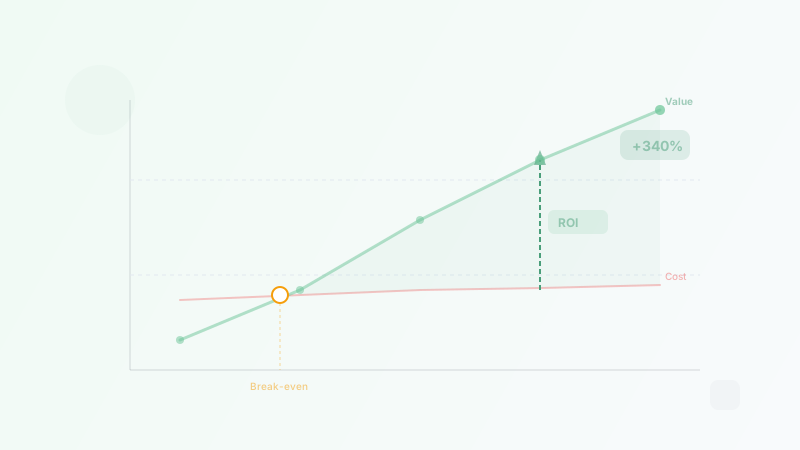
The ROI of Hiring a Virtual Assistant: How to Calculate Your Savings
Calculate the real ROI of hiring a virtual assistant. Covers formulas, time recovery, opportunity cost, break-even analysis, and real-world examples.